Fishermen and Albufeira's Mayor Form a Human Chain at Praia da Rocha Baixinha — €108M PRR Desalination Plant Faces Off Against the Algarve Coast as Construction Set to Start Next Week
Around 100 fishermen and Albufeira mayor Rui Cristina formed a human chain Saturday against the €108M PRR desalination plant. Construction starts next week; intake and brine outfall in consultation until 11 May.
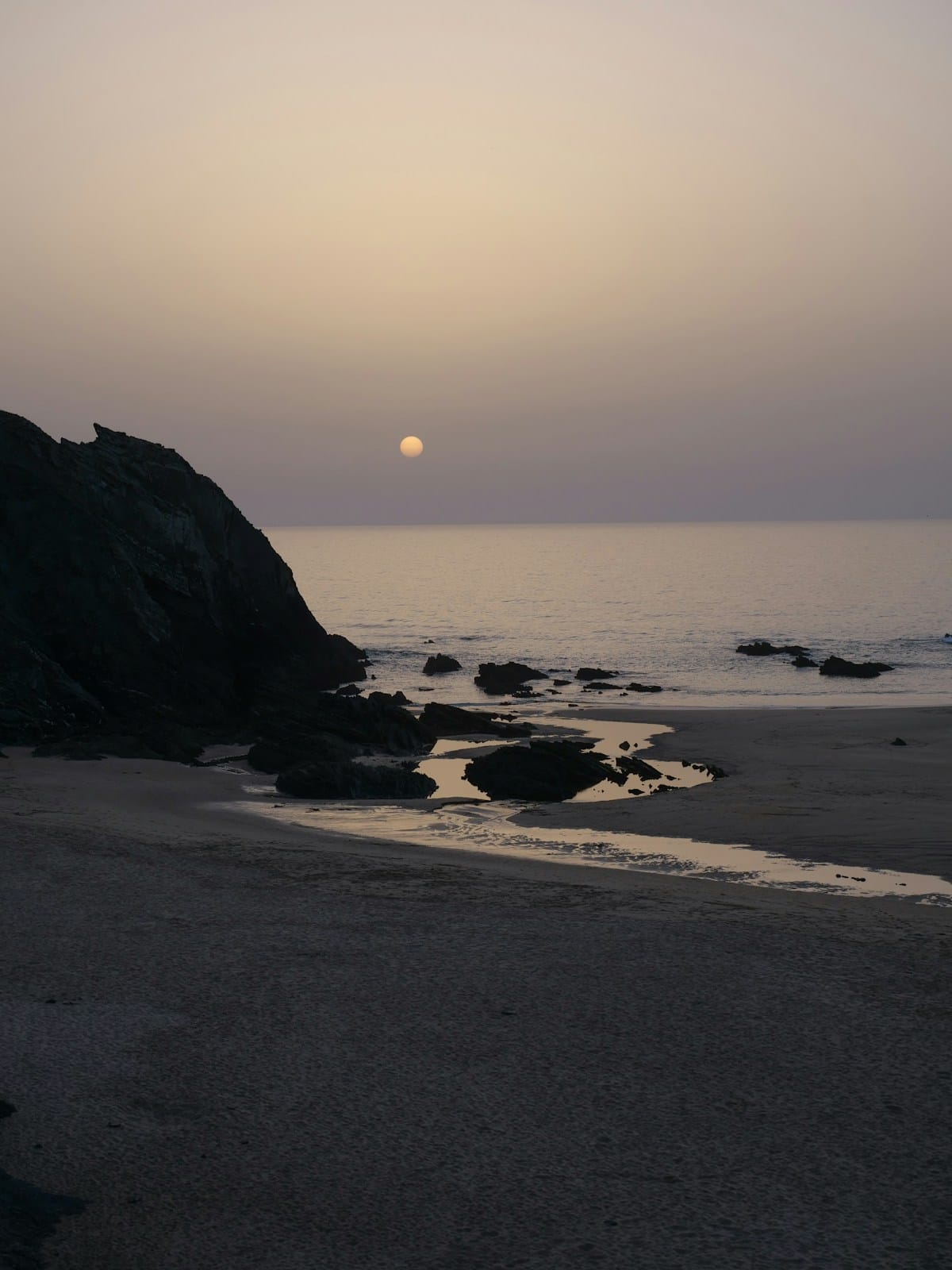
Around a hundred people walked into the surf at Praia da Rocha Baixinha on Saturday, 25 April 2026, joined hands across the wet sand and a line of small fishing boats, and held the position long enough to make a single point: the desalination plant the Government wants to build at Praia da Falésia, three kilometres along the same Albufeira coast, should be reviewed before the bulldozers arrive next week.
The action was organised by two Algarve fishing associations — Quarpesca (the shipowners' and fishermen's association of Quarteira) and Baleeira (Albufeira's sport-fishing association) — with eighteen small fishing boats joining a parallel maritime march. Fishermen, families, local residents and Albufeira's mayor Rui Cristina (Chega) formed the cordão humano. The protest used the 25 de Abril holiday for visibility, but the operational driver was the Friday final authorisation from Environment Minister Maria da Graça Carvalho greenlighting construction.
The €108 million PRR plant the protest is trying to slow
The desalination unit is the centrepiece of the State's Algarve drought response. The headline numbers are well established:
- Investment: €108 million, fully financed by the Plano de Recuperação e Resiliência (PRR).
- Operator: Águas do Algarve, the regional water utility owned by Águas de Portugal.
- Location: Praia da Falésia in Albufeira, with the seawater intake and brine outfall in the maritime space immediately offshore.
- Capacity: Designed to add a non-rainfall-dependent supply tier for the Algarve's drinking-water system, supplementing the Bravura, Funcho and Odeleite reservoirs.
The plant has cleared the principal procedural milestones — Environmental Impact Declaration approved, public consultation completed, and the DECAP (Declaração de Conformidade do Projecto de Execução) issued — and Maria da Graça Carvalho's authorisation on Friday opens the door to construction starting in the week beginning 28 April.
What the protesters are actually contesting
Two technical pieces of the project are still legally open. The seawater intake system — two parallel pipelines roughly 2,042 metres long ending in two submerged concrete intake towers — and the brine discharge outfall — a pipe of around 2,260 metres located about three kilometres west of the intake — were placed on the Participa.pt platform for public consultation under the maritime-space-use procedure, with comments open until 11 May 2026.
Adriano Sabino, president of Baleeira, told reporters at the beach the action ‘visou dar voz às pessoas que não participaram na consulta pública ou que não tiveram conhecimento da mesma’ — aimed at people who didn't take part in the public consultation or didn't even know it was happening. His point was about process: the population, in his telling, only understood the project in detail after the Government had already taken its decision.
Mayor Rui Cristina's intervention focused on substance. He told reporters the project ‘contains errors’ and called for revision, citing concerns about brine discharge effects on tourism, marine life and the Blue Flag beaches that anchor Albufeira's summer economy. The municipality has positioned itself frontally against a Falésia siting since at least the 19 April Público interview in which Carvalho said she wanted to meet the mayor before the works start.
Why the Government is moving anyway
Maria da Graça Carvalho's case rests on three numbers that the Algarve drought file has produced repeatedly across 2024 and 2025: declining precipitation, rising evaporation, and tourism load. The minister has been explicit that scientific studies indicate reduced rainfall and higher evaporation in coming years, that droughts will become more frequent, and that the agricultural, tourism and supply systems of the Algarve cannot rely solely on rainfall-fed reservoirs.
The PRR funding adds an operational constraint: the Plano has hard execution deadlines, with the bulk of disbursements running through August 2026, and contracts that miss the works-start window are exposed to the kind of fund-loss decisions that have already cost Portugal nominal envelopes elsewhere. The €108 million is a concrete envelope tied to a concrete site.
The political shape of the row
The Albufeira fight is unusual for a national infrastructure dispute in that the local political map is partially inverted: a Chega-aligned mayor stands against a PSD-led national Government on a project the previous PS Government commissioned. The PS Algarve federation has publicly defended immediate construction, calling for the works to start without further delay. The Comunist PCP has supported the local protest movement, and BE has aligned with the environmental NGOs raising brine-discharge concerns.
Within Albufeira itself, the central tourism-vs-supply argument has split the hospitality industry. Hotel and golf operators are net consumers of water and have been broadly supportive of the desalination capacity; the smaller-boat fishing community and the Blue Flag-dependent beach concessionaires sit on the other side.
What happens next — week of 28 April
The legal architecture for the works to start exists. The Friday authorisation closes the chain of permits for the plant itself; the parallel maritime-space consultation does not block the inland construction site, and Águas do Algarve has indicated it intends to mobilise contractors immediately. Three things are worth tracking in the week ahead:
First, whether the 11 May Participa.pt deadline on the intake and outfall produces a volume of comments large enough to force a written response from APA (Agência Portuguesa do Ambiente), which is the standard accountability pressure point for high-attention public consultations.
Second, whether Maria da Graça Carvalho's promised meeting with Mayor Cristina produces any modifications to the brine-discharge configuration or to the monitoring and compensation regime around the Blue Flag beaches.
Third, whether the fishing community escalates. The two associations that ran the Saturday human chain have indicated further actions are possible, including coordinated marine demonstrations during the Easter and pre-summer tourism windows. The pattern in earlier Algarve infrastructure disputes (the Tavira-Faro railway upgrades, the dredging campaigns at Olhão) is that maritime protests escalate when intakes and outfalls become physically visible to the local population.
What it means for residents and visitors
For now, nothing changes legally for residents on the Algarve water system. Drinking-water supply continues to come from the existing reservoir-and-treatment chain. Drought restrictions, where in force, remain governed by the regional drought commission's calendar.
For property owners and rental operators on the Faro coast, the relevant indicator is whether the brine-discharge outfall ends up substantially modified during the consultation, because that is the dimension that affects the marine biology argument and, by extension, the Blue Flag eligibility of the immediately adjacent beaches. Anyone with comments to file on the intake or outfall has until 23:59 on 11 May 2026 to lodge them on participa.pt.
Related on The Portugal Brief: free walk-in HIV and hepatitis screening at AML pharmacies. On the Portuguese blue-carbon and coastal-restoration tape, our read on the Fundo Ambiental's €1-million 2026 disbursement of the Floresta Azul marine-meadow restoration programme across Ria Formosa, the Sado estuary and the Natura-2000 coastal sites sets the latest reference. On the 1 June praia-vigiada beach-safety side, our 31 May read on ISN manning the 1 June Praia-Vigiada surveillance window across the Portuguese coast — credentialed nadadores-salvadores under Portaria 53/2014 deploy through 30 September across the 350-plus praias vigiadas, the bandeira verde-amarela-vermelha-xadrez frame governs swimmer admissibility on a daily readout, and the praias-não-vigiadas perimeter on the Costa Vicentina, Costa Alentejana and the remote Açorean-Madeiran coves carries the structural drowning-severity tail sets the latest reference. On the green-cities, sustainability and climate-adaptation side of the file, Porto's shortlisting for the 2028 European Green Capital sets the latest reference. On the fisheries and coastal-access side of the file, our guide to the recreational sea fishing licence sets the latest reference. On the coastal-management side of the file, the invasive alga Portugal is not allowed to sell sets out why EU law bans placing Rugulopteryx okamurae on the market and which document would unlock it. On the mechanics of objecting to something like this, how to file in a Portuguese public consultation, and the reply the state owes you sets out the three consultation regimes, the statutory windows of 30, 20, 15 and 10 days, the fact that nationality is not a criterion in any of them, and the reasoned written reply a council is obliged to give anyone who invokes one of the three grounds in article 89(3) of the RJIGT.