EU's Entry/Exit System Now Fully Operational at All Portuguese Borders — Non-EU Travellers Face Queues of Up to Four Hours
The European Union's Entry/Exit System — the biometric border-control regime that replaces passport stamps with digital fingerprint and facial-image records — became fully operational at all Schengen external borders on 10 April 2026. For the...
The European Union's Entry/Exit System — the biometric border-control regime that replaces passport stamps with digital fingerprint and facial-image records — became fully operational at all Schengen external borders on 10 April 2026. For the millions of non-EU nationals who travel through Lisbon, Porto and Faro each year, the change means longer queues, new documentation requirements and a fundamentally different experience at passport control.
What the EES Does
The system digitally records the entry, exit or refusal of entry of every non-EU national travelling for a short stay of up to 90 days within any 180-day period. At first entry, travellers must provide four fingerprints and a facial image. The biometric data is stored centrally and checked on every subsequent crossing, replacing the ink stamps that border officers have used for decades.
The stated goal is to automate the detection of visa overstayers, strengthen security at Schengen's external borders and reduce document fraud. The system also feeds into the forthcoming European Travel Information and Authorisation System (ETIAS), which will require visa-exempt travellers to obtain pre-travel clearance from late 2026.
Portugal's Rocky Road to Implementation
Portugal first launched the EES on 12 October 2025 but suspended it at Lisbon Airport just two months later after queues stretched to several hours and passengers missed connecting flights. The SEF's successor agency brought in 24 officers from the National Republican Guard in January to ease pressure at the capital's border checkpoints.
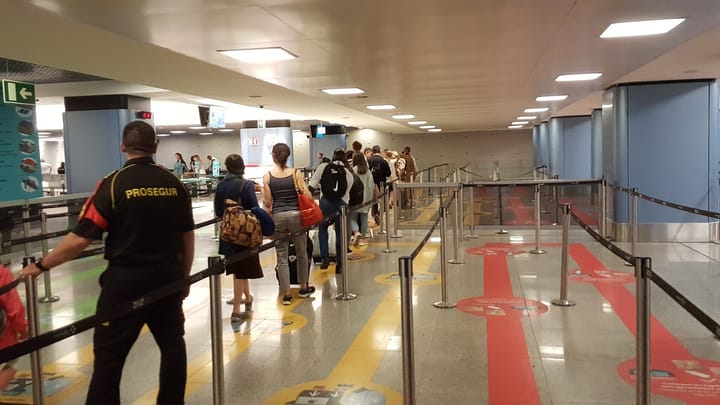
The full rollout on 10 April — timed, controversially, to coincide with the Easter travel rush — has again produced significant delays. Airports across the Schengen zone, including Lisbon, have reported wait times of up to four hours for non-EU passport holders in the first week. Belgium, Spain and France have experienced similar congestion.
What Non-EU Residents Should Know
Holders of Portuguese residence permits are processed through the EES but benefit from a shorter procedure at subsequent crossings once their biometrics are registered. The first crossing will take longer — travellers should allow at least two additional hours at the airport.
The EU's Travel to Europe mobile app, which allows travellers to pre-register some data before arriving at the border, is currently available in Portugal and Sweden, with plans to expand across the bloc. Using the app can reduce processing time at the gate.
British nationals, who since Brexit are treated as third-country nationals at Schengen borders, are among those most affected. UK travellers to Portugal — the country's largest source of non-EU tourism — should expect the new biometric checks on every entry and exit.
Looking Ahead
The European Commission has acknowledged teething problems but insists the system will speed up border crossings once the majority of regular travellers have completed their first biometric registration. Portugal's airports, already operating near capacity, will be a key test of that promise as the summer season ramps up.