Charging an Electric Car in Portugal
Researched and written with AI tools from official sources. How we make our guides
How public charging works in Portugal: the MOBI.E network, how to pay, what a charge costs, and charging at home or in an apartment building.
Last verified: October 2026.
Who this is for
- You drive, or plan to buy, an electric or plug-in hybrid car in Portugal.
- You want to know which card or app to get, what a charge costs, and how to pay.
- You are visiting with an electric car and need to charge without a Portuguese contract.
Not for you if: you want the general rules of the road, tolls, and fines. Read Driving in Portugal instead.
Updated October 2026. A law published on 31 July 2026 extended the transition period for the public charging network. Your existing charging card or app keeps working on the MOBI.E network until 31 December 2027.
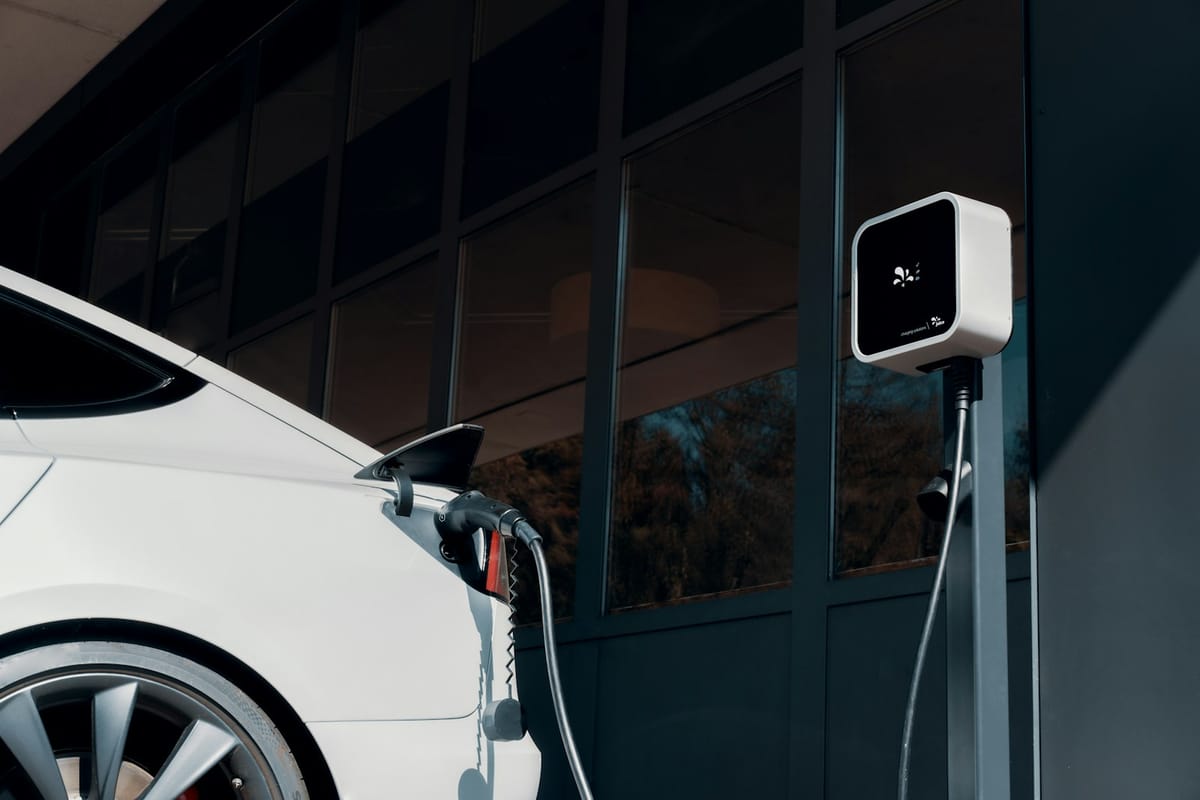
Most public chargers in Portugal belong to one national network, run through MOBI.E, a state-owned company. You can charge with a card or app from any of more than 25 providers, and it works at almost every station on that network. Newer stations also let you pay by bank card, with no contract. Each charge has three parts: the energy, a fee for using the station, and VAT. The station fee is always shown at the charger. At home, your car simply uses your normal electricity contract.
How the public network works
Since 2025, Portugal has had two kinds of public charging network.
The network connected to MOBI.E. This is the national, fully linked network. Its stations carry the MOBI.E logo. One contract with one provider lets you charge at stations run by nearly a hundred operators. MOBI.E runs the platform that links them, settles payments between companies, and shows live availability.
Networks not connected to MOBI.E. A new law in August 2025 allowed operators to run their own networks outside the platform. These stations set their own access rules. You pay by bank card, or through a provider that has a deal with that operator. Check prices on the operator's own website or app.
Three kinds of company appear on your bill:
- Your electric mobility provider. This is the company that gives you the card or app and sends you the bill. In Portuguese it is the CEME (comercializador de eletricidade para a mobilidade elétrica). Under the new law these providers are being replaced by service providers (EMSP).
- The charging point operator (OPC). This company owns or runs the charger and sets the fee for using it.
- MOBI.E, which manages the platform during the transition period.
The transition period and what changes in 2028
The new law ends the old model, where everything ran through MOBI.E. A transition period runs until 31 December 2027. During it:
- your current card or app keeps working on the MOBI.E network
- operators can choose to stay connected to MOBI.E or leave
- if a station leaves the platform, your card stops working there
From 1 January 2028, operators sell electricity directly to drivers. Paying by bank card becomes mandatory at all public stations on the main European road network (TEN-T). Before then, check that your card or app is still valid and read any new terms your provider sends you.
Ways to pay at a public charger
With a contract (card or app). You sign up with a provider and get a card (RFID) or app. On the MOBI.E network, it works across all connected stations. You can have contracts with more than one provider.
Without a contract. You can pay by physical or digital bank card. You either scan a QR code that opens a payment page, or use a card terminal at the station. Not every older station has this option yet.
Through a roaming app. MOBI.E lists apps that let visitors charge straight away, with no Portuguese contract. Install and test the app before you travel.
If a station is offline, you usually need a physical card. Some operators only accept cards checked online, so the card may still be refused. Every operator must offer a free phone line, open 24 hours a day, for faults.
What a charge costs
On the MOBI.E network, your bill is built from three parts.
- The energy part. This is your provider's price for the electricity. It includes network access charges and a small electricity tax of €0.001 per kWh on the mainland. Your provider's price stays the same whichever operator's charger you use.
- The station part. This is the operator's fee for the charger. It can be per kWh, per minute, per charging session, or a mix. It is always shown at the charger. You can also check it, station by station, on the MOBI.E map.
- VAT. It applies to the whole bill: 23% on the mainland, 22% in Madeira, and 16% in the Azores.
There is also a small platform fee. ERSE, the energy regulator, sets it each year. For 2026 it is €0.1088 per charging session, paid by providers and operators, down from €0.1572 in 2025. You do not see it as a separate line, but it feeds into the price you pay. ERSE estimates it makes up 3% to 4% of the final price.
On networks not connected to MOBI.E, the bill can look different. It may include an optional monthly membership fee and a service fee. These invoices can show the total only, while MOBI.E network invoices must list each part.
Watch per-minute fees. If an operator charges per minute, the clock keeps running while your car sits at the charger. Check how the fee works on the screen before you start, and move the car once you are done.
Choosing a provider
The provider you pick sets your energy price everywhere on the MOBI.E network. So it is the main way to lower your costs.
- Open ERSE's list of offers for electric mobility providers. It shows each provider's prices and conditions, with no data to enter.
- Think about how you charge. Mostly slow charging near home is different from frequent fast charging on motorways.
- Check the station fees for the chargers you use most, on the MOBI.E map.
- Sign up with the provider you choose, on its website or app.
- Keep the card in the car, even if you mostly use the app. You need it at offline stations.
Some providers offer monthly plans. Read the contract for any minimum term before you sign.
Charger speeds
MOBI.E groups stations on its network by power:
| Type | Power | Typical full charge |
|---|---|---|
| Standard | Under 7.4 kW | Can take more than 8 hours |
| Semi-fast | 7.4 kW to 22 kW | Up to 4 hours |
| Fast | Over 22 kW, up to 150 kW | About 1 to 1.5 hours |
| Ultra-fast | 150 kW or more | Up to 1 hour |
Your car limits what you can use. Many plug-in hybrids cannot use fast or ultra-fast chargers. Only some fully electric models can use the full power of an ultra-fast charger. Ask your dealer which charger types suit your car.
Check the connector too: Type 2 (Mennekes), CCS, or CHAdeMO. You can filter the MOBI.E map by connector and power.
Charging at home
If you have a garage or a private parking space, charging at home is usually the cheapest option. ERSE treats your car as one more appliance on your electricity contract. You can often charge at night on a cheaper time-of-use tariff. See Setting Up Electricity in Portugal for contracts and tariffs.
Use a certified installer. The charger must be installed to the technical rules of DGEG, the energy directorate.
If you rent, talk to your landlord before any work is done.
Charging in an apartment building
If you own a flat with a parking space in the building's garage, you can install a charger for your own space.
- Tell the building's administration. You must tell the condominium administration (administração do condomínio) that you plan to install a charger. MOBI.E publishes a model letter.
- Choose an installer. Contact a manufacturer, a certified installer, or a charging point operator.
- Decide whether to connect to MOBI.E. It is optional during the transition period. If you connect, your charging is billed to your own card or app, so it never lands on the building's shared bill. Connecting is no longer possible after 31 December 2027. After that, a separate meter splits your use from the building's.
The administration cannot block your charger, with three exceptions:
- a shared charger for all owners is planned within 90 days of your letter
- the building already has a shared charger
- your charger would put the building's safety at risk or damage its architecture
The building can also install shared chargers in common areas, with each owner paying for their own energy.
Tips for drivers
- Check the station fee on the screen before you plug in. Two chargers in the same car park can belong to different operators, with different fees.
- Slow charging is generally cheaper. Use it where you will stay a while, such as at a hotel, a restaurant, or overnight.
- Plan rural trips. Chargers are densest around Lisbon and Porto. In rural areas, plan stops ahead, using fast chargers on the motorways if needed.
- Ask about parking. Some town halls give reduced or free parking to electric cars. Check your town hall's website.
- Road tax. Fully electric cars do not pay the annual road tax (IUC). Plug-in hybrids do. See Paying Road Tax and Vehicle Inspection.
Where to check official information
- MOBI.E: station map with live availability and fees, list of providers and operators, apps for visitors, and building installation forms.
- ERSE: list of provider offers, platform fees, and how prices are built. ERSE also handles energy complaints.
This guide is general information, not legal advice. Prices and rules change; check the official source before you act.
Sources
This guide is written from official sources and, where relevant, organisations' own websites.
- MOBI.E, Cost of Charging: https://www.mobie.pt/en/chargevehicle/costofcharging (three bill components, €0.001 per kWh electricity tax under Portaria n.º 320-D/2011, provider price constant across operators, station fee shown at the charger and on the map, VAT 23%, 22%, and 16%, extra fees and invoice rules off the MOBI.E network, power classes and typical charging times, plug-in hybrid limits), checked 2 October 2026
- MOBI.E, How to Charge: https://www.mobie.pt/en/chargevehicle/howtocharge (contracts with one or more providers, offline stations need a card, networks not connected to MOBI.E, free 24-hour fault line), checked 2 October 2026
- MOBI.E, Are You Travelling Through Portugal in an Electric Vehicle?: https://www.mobie.pt/en/mobility/are-you-travelling-through-portugal-in-an-electric-vehicle (more than 25 providers, nearly a hundred operators, ad hoc payment by QR code or card terminal, visitor apps, connector types, station density, slow charging cheaper, municipal parking reductions), checked 2 October 2026
- MOBI.E, New Legal Framework for Electric Mobility: https://www.mobie.pt/en/mobility/new-legal-framework-electric-mobility (new framework in force August 2025, transition to 31 December 2027, cards keep working on the connected network, bank card payment mandatory on the TEN-T network from 1 January 2028, operators sell directly, internal meters), checked 2 October 2026
- MOBI.E, Legislation and Regulation: https://www.mobie.pt/en/mobility/legislation-and-regulation (Decreto-Lei n.º 93/2025 of 14 August, longer transition by Decreto-Lei n.º 155/2026 of 31 July, ERSE Regulamento n.º 7/2026, EU Regulation 2023/1804 (AFIR)), checked 2 October 2026
- MOBI.E, EGME tariff 2026 notice (16 December 2025): https://www.mobie.pt/en/w/tarifa-egme-volta-a-baixar-em-2026 (€0.1088 per session in 2026, €0.1572 in 2025, 3% to 4% of the final price according to ERSE), checked 2 October 2026
- MOBI.E, In Condominiums: https://www.mobie.pt/en/installstations/in-condominiums (telling the administration, model letter, installer types, optional connection, three grounds on which the administration can object, shared chargers, DGEG technical guide), checked 2 October 2026
- ERSE, Mobilidade Elétrica, Tarifas e Preços: https://www.erse.pt/mobilidade-eletrica/tarifas-e-precos/ (EGME tariffs set yearly by ERSE; 2026 values approved by Diretiva n.º 12/2025 of 29 December), checked 2 October 2026
- ERSE, Mobilidade Elétrica, Carregamento: https://www.erse.pt/mobilidade-eletrica/funcionamento/carregamento/ (roles of provider, operator, and network manager; home charging as one more load on the installation), checked 2 October 2026
- ERSE, Simuladores, Mobilidade Elétrica: https://www.erse.pt/simuladores/mobilidade-eletrica/ (list of provider offers with prices and conditions, no data entry), checked 2 October 2026
- Portal das Finanças, IUC Code, article 5: https://info.portaldasfinancas.gov.pt/pt/informacao_fiscal/codigos_tributarios/iuc/Pages/iuc5.aspx (electric cars exempt from IUC), carried from verified guide W2B-37, checked 1 October 2026
Last verified October 2026. Rules and fees change; check the official source before acting.