Corticeira Amorim's Margin Squeeze Is a Signal for Portugal's Quiet Export Champion — Why the €939 Million Cork Group's 2024 Miss Is Still the 2026 Story
Cork is Portugal's quietest export champion — over 90% of production ships abroad, with Corticeira Amorim alone turning out three billion wine stoppers a year. The group's 2024 revenue of €939.1 million fell 4.7%, and the EBITDA margin contraction has not yet been fully absorbed heading into 2026.
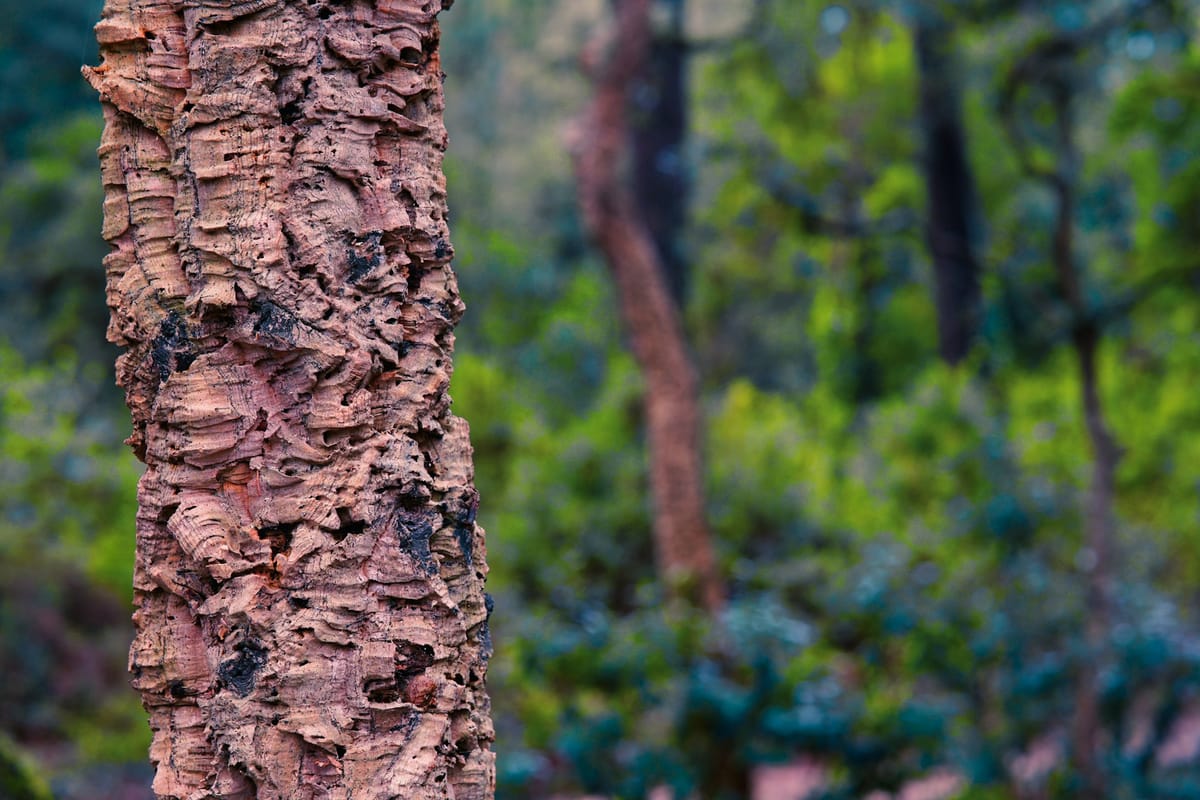
Cork — cortiça — is the most under-discussed large export Portugal has. The country produces roughly half the world's cork and its one dominant processor, Corticeira Amorim, turns out more than three billion natural wine stoppers a year. Over 90% of what the Portuguese cork industry makes goes abroad. And yet, walk into any Lisbon expat conversation about the Portuguese economy and the subject rarely comes up.
It should this year. Corticeira Amorim closed 2024 with consolidated sales of €939.1 million, a 4.7% decline on the prior year. The EBITDA margin compressed to 16.8% — meaningfully below the group's historical run-rate — squeezed by three forces at once: lower wine-industry demand in Europe and the United States, higher prices for raw cork planks, and a 2023 harvest that converted into worse-than-average processed yields. None of those inputs have yet reset.
Why cork is economically different from the rest of Portuguese agriculture
Cork oaks (sobreiros) are stripped once every nine years — a cycle fixed in Portuguese law since the Middle Ages. That rhythm means the industry cannot respond to a demand shock by planting more, or a glut by harvesting less. It has exactly what the forest gives it, and the entire global market (France's Oeneo, Italy's Ganau, Spain's smaller processors) works from the same Iberian raw material, which Portugal supplies in its majority.
That is what makes Corticeira Amorim, alongside APCOR (the industry association), effectively a global price-setter in cork stoppers and a material influence on composite-cork industrial products — wall coverings, flooring, aerospace-grade insulation, sports-ball cores. It is a textbook Portuguese industrial asset: rooted in Alentejo geography, globally dominant, but vulnerable to wine-cycle swings because cork stoppers are around 70% of the industry's exports.
The wine cycle is the problem
Global still-wine volumes have been trending down for three years. The OIV's annual data has shown falling consumption in every major developed market, and the United States — the largest premium-cork destination — has been flat to weak since 2023. Champagne and sparkling have held up better, and that is visible in Amorim's sub-segment numbers, but natural cork stoppers for premium still wine — the core margin business — have been selling below prior-year volumes.
Lower wine volumes hit cork two ways. First, directly: fewer bottles means fewer stoppers. Second, indirectly: when wine producers are under pressure on their own margins, they switch to cheaper closures — agglomerated corks, technical stoppers, screw caps. Natural cork's premium-pricing argument (terroir, ageing, tradition) holds with high-end producers but erodes in the mid-market exactly when the mid-market is the most stressed.
What Portugal gets out of it
Even with 2024's softness, the cork sector remains one of the most consistent contributors to Portugal's positive trade balance in manufactured goods. APCOR data has historically put annual Portuguese cork exports at the €1 billion order of magnitude — a small number next to automotive components or footwear, but far more domestically retained value, because the entire supply chain from montado (cork oak forest) to finished stopper sits inside the country. Employment is concentrated in the Alentejo and the Vale do Sousa (Feira, Santa Maria da Feira), where the sector remains one of the largest private employers.
The 2026 read
Corticeira Amorim's 2024 annual report described an "unfavourable global context". The 2025 trading environment did not visibly repair it: wine consumption remained soft, cork input prices remained elevated, and the group has been reworking its capacity utilisation rather than ramping. For 2026, the optimistic case is that 2023's bad harvest-yields wash out of inventory and the Asian premium-wine market continues to pull natural-cork bottles. The pessimistic case is that the structural decline in wine volumes is the story of the next decade and cork has to find meaningful non-wine demand — composite products, construction materials, aerospace — fast enough to replace it.
Neither scenario will be legible in a quarterly number. But for anyone tracking Portugal's export base beyond tourism and real estate, the sobreiro is where the industrial story still lives — and 2026 is the year it has to prove it. On the pharma-cluster side, our read on the Hovione co-CEO succession (António Almeida and Marco Gil from 21 May, Jean-Luc Herbeaux out, permanent search open) sets the latest reference. On the Corticeira Amorim, Scott Laboratories, Scott Premium Closures JV, ACIC Cork & Closures, cork industry and Amorim US-and-Canada wine and spirits closures side of the file, our 15 June read on Corticeira Amorim splitting its US closures arm 50/50 with Scott Laboratories — the Scott Premium Closures joint venture absorbing ACIC Cork & Closures for the North American wine and spirits market, with a €15 million estimated 2026 sales impact and the Amorim Cork US-Canada commercial setup re-anchored under the JV sets the latest reference. On the land itself, the rush of institutional money into Portuguese farmland shows who is buying up the countryside.