Banking in Portugal for Expats 2026: Local Banks, Revolut, Wise and What Actually Works
Opening a bank account in Portugal as an expat is straightforward if you know the process. Here is a practical guide to local banks, digital alternatives, and what the expat community actually uses in 2026.

Banking is one of the first practical hurdles new arrivals in Portugal face. The good news: the process is considerably smoother than it was five years ago, and the combination of local and digital banking options available in 2026 means most expats can get fully set up within a week of arriving.
Do You Need a Portuguese Bank Account?
For short stays, no. Revolut, Wise, and other digital banks work perfectly well for daily transactions in Portugal. But for longer-term residency, a Portuguese account becomes important for: paying rent (most landlords require a Portuguese IBAN for direct debit), setting up utility contracts, receiving Portuguese salary payments, and certain government transactions (NHR registration, tax refunds).
Getting Your NIF First
Before opening any Portuguese bank account, you need a NIF (Número de Identificação Fiscal — tax identification number). Get this at any Finanças office (bring your passport and address proof) or appoint a fiscal representative to obtain it remotely before you arrive. NIF obtainment is usually same-day. Without it, no bank will open an account.
Portuguese Banks — the Main Options
Millennium BCP — the most widely used bank among expats. English-speaking staff at larger branches, solid app, and a relatively straightforward account opening process. Requires NIF + proof of address (rental contract or utility bill) + passport. Basic account fees: €4-6/month (waived with minimum balance or salary deposit).
Caixa Geral de Depósitos (CGD) — the state-owned bank. Largest branch network in the country, useful for areas outside major cities. Less polished app than competitors but universally accepted. Similar fee structure to BCP.
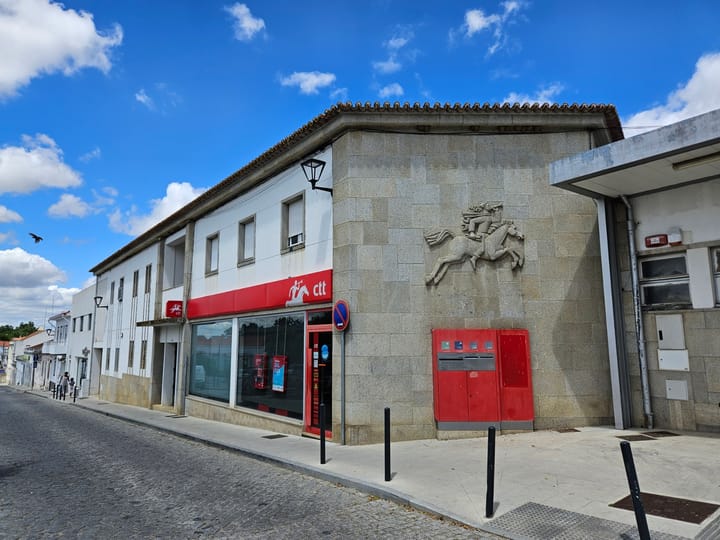
Banco CTT — operated through post office branches, surprisingly modern app, and zero-fee basic accounts. Lower minimum balance requirements. Good option if you want to avoid monthly fees.
Novobanco and Santander Portugal — both solid mid-tier options with reasonable English support and competitive mortgage products (relevant if you plan to buy property).
ActivoBank (owned by Millennium) — digital-first, no monthly fees for basic account, solid app. Requires an in-person appointment at one of their limited branches to open.
What Documents You Need
- Passport (or EU ID card)
- NIF
- Proof of Portuguese address (rental contract is best; utility bill works; some banks accept a letter from your employer or landlord)
- Proof of income or employment (not always required for basic accounts but useful)
Non-residents can open accounts at some banks (particularly CGD and BCP), but you may only be eligible for a non-resident account with higher fees and limited features. Establishing residency first — even with a short-term visa — generally unlocks better terms.
Digital Banks — Revolut and Wise
Revolut: Widely used in Portugal and fully functional for daily life. Portuguese merchants, ATMs, and online payments all work seamlessly. Not a Portuguese bank (registered in Lithuania), so no Portuguese IBAN — this is the key limitation. Landlords, utility companies, and some government services require a Portuguese IBAN. Use Revolut as a complement, not a replacement.
Wise: Offers a Portuguese IBAN (IBAN starting with PT) since Wise is licensed in Portugal. This solves the IBAN problem and makes Wise viable as a primary account for many expats. Currency conversion fees are transparent and typically lower than traditional banks. No monthly fee for the basic account. The main limitation: no physical branches and limited Portuguese-language support.
N26: Works in Portugal but registered in Germany — no Portuguese IBAN, same limitation as Revolut.
What the Expat Community Actually Uses
The most common setup among expats in Portugal in 2026:
- Wise for the Portuguese IBAN (rent, utilities, government transactions) and international transfers
- Revolut for daily spending, currency exchange, and travel
- A local bank account (usually BCP or CGD) for mortgage payments, salary receipt, or when a traditional bank is specifically required
Many expats find they can function indefinitely with Wise + Revolut without ever needing a traditional Portuguese account. Others prefer having a local account for peace of mind. Both approaches work.
ATMs and Cash
Portugal uses the Multibanco network — one of Europe's most efficient ATM systems. Multibanco machines also pay bills, top up mobile phones, and process a range of government payments. All major international cards (Visa, Mastercard) work at any ATM; Revolut and Wise cards work too. Cash is less necessary than in many European countries — card payments are accepted almost everywhere, including small cafes and market stalls.
The Portugal Brief covers news and policy for expats and internationals. For foreign residents on the Portuguese-banking documentary chain, our 2026 guide to opening a Portuguese bank account — the NIF prerequisite, the Lei 83/2017 AML documentary chain, the CGD vs Millennium vs Santander vs BPI vs Novobanco vs Bankinter matrix, the ActivoBank and BiG digital tracks, and the Conta-Base / Serviços Mínimos Bancários free-account backstop sets the latest reference. On the banking-supervision side, our read on the Banco de Portugal Folheto de Comissões reformulation (multi-year programme through 2028, Comparador de Comissões expansion, €8.91M undue commissions refunded in 2025) sets the latest reference. On the Portuguese payments-infrastructure and conduct-of-business tape, our read on SIBS-FPS's 13 May 2026 withdrawal of its sixteen-month-old TACL administrative action against the Banco de Portugal on the EU 751/2015 scheme-vs-processor separation file sets the latest reference. For how the SIBS Multibanco and MB Way rails actually work in 2026, our 2026 MB Way and Multibanco guide — the SIBS-operated domestic card rails, the 11,000-plus ATM network, the Entidade-Referência-Montante bill-payment substrate that carries IRS, IVA, IUC and utility settlements, the €750-per-transaction MB Way P2P caps and the MB Spot agent-based cash-in/cash-out service for freguesias without a bank branch sets the latest reference. On the rural cash-access and Multibanco Social rail, our 21 May Multibanco Social read — the SIBS pilot installing cash machines inside roughly twenty juntas de freguesia in the cash-desert interior, the 1,200+ parishes without any physical cash-out point, the seventeen-kilometre worst-case walk to an ATM, Banco de Portugal governor Álvaro Santos Pereira aligned on the rollout, and the cash-in-shop and mobile-branch tracks running alongside sets the latest reference. On the digital-fraud and payments-safety side, our 25 May read on the Banco de Portugal launch of the Plataforma de Monitorização da Fraude Digital with SIBS, telecoms and the PJ — €6.5 million of losses blocked since the May 2024 IBAN-beneficiary tool, 2,577 fraud-related complaints in 2025 (+45% YoY), and 85% of fraudulent-transfer losses currently borne by the user the platform is designed to compress back to the institutional layer sets the latest reference. On the Portuguese bank account, non-resident track, Activobank, Millennium BCP, CGD, Novobanco, Multibanco, IBAN, MB Way and CRS/DAC2 cross-reporting side of the file, our 2026 practical guide to opening a Portuguese bank account as a non-resident — the NIF + comprovativo de morada stack, the Activobank / Millennium BCP / CGD / Novobanco / Bison Bank line-up, the Multibanco network, MB Way and the CRS/DAC2 cross-reporting frame sets the latest reference. On the cash, payments and financial-access side of the file, our read on Portugal co-founding Denaria Europa to defend the right to pay in cash sets the latest reference. On the NIF, tax-number and bank-account side of the file, our practical guide to getting your NIF and opening a Portuguese bank account sets the latest reference.